In my last post, I wrote about why Pilates can start to feel different after 40, especially when strength, balance, and control begin to matter in a more noticeable way.
This post is the practical follow-up, because balance is one of the places where that shift becomes easiest to see.
Not because balance suddenly disappears after 40. It doesn’t. Balance changes gradually, and some research suggests measurable differences may show up by midlife. UCLA Health summarized one study where adults around age 50 saw, on average, a 25% drop in how long they could balance on one leg compared to adults in their 30s and 40s. The decline becames more noticeable in later decades.
That’s a pretty solid reason to train balance before it feels like a problem . . . Pilates gives us a very clear way to do that.
Balance shows up when the body has fewer places to hide
We recently spent some time doing unilateral work in class. Working one side at a time has a way of revealing what bilateral movement lets us hide. When both sides are working together, the stronger side can quietly help out. The more coordinated side can take over. The body can find a workaround and make it look like everything is fine.
When you take one side away, imbalances can quickly show up.
One side feels steady and reliable. The other feels less certain. A foot grips. A hip hikes and takes over. An ankle wobbles. You might even catch yourself holding your breath, hoping that will help steady the imbalances.
Relatable, but unfortunately not a long-term balance strategy.
That’s why unilateral work is so useful. It doesn’t expose failure. It simply reveals information.
What balance asks from your body
When someone feels unsteady, it’s easy to think, “I need better balance.” But balance isn’t just one thing. It’s the result of several systems working together.
Balance asks for:
Foot and ankle awareness
Hip stability
Core support
Strength and reaction time
Visual focus
Breath control
Confidence under load
When one of those pieces feels less reliable, balance can feel . . . well, unbalanced.
That might show up during standing work, lunges, step-downs, side splits, single-leg bridging, or even the transition from the supine on the reformer to standing. Nothing dramatic. Just less margin than before.
This is also why standing Pilates work can be so useful. It connects the control we build on the mat or reformer to the way we actually move through life: stepping, shifting weight, carrying things, getting up and down, and catching ourselves when something unexpected happens.
That’s where Pilates becomes useful. It gives the body controlled opportunities to practice responding, adjusting, and organizing itself without turning the whole thing into a circus trick.
Balance progressions and a supportive box
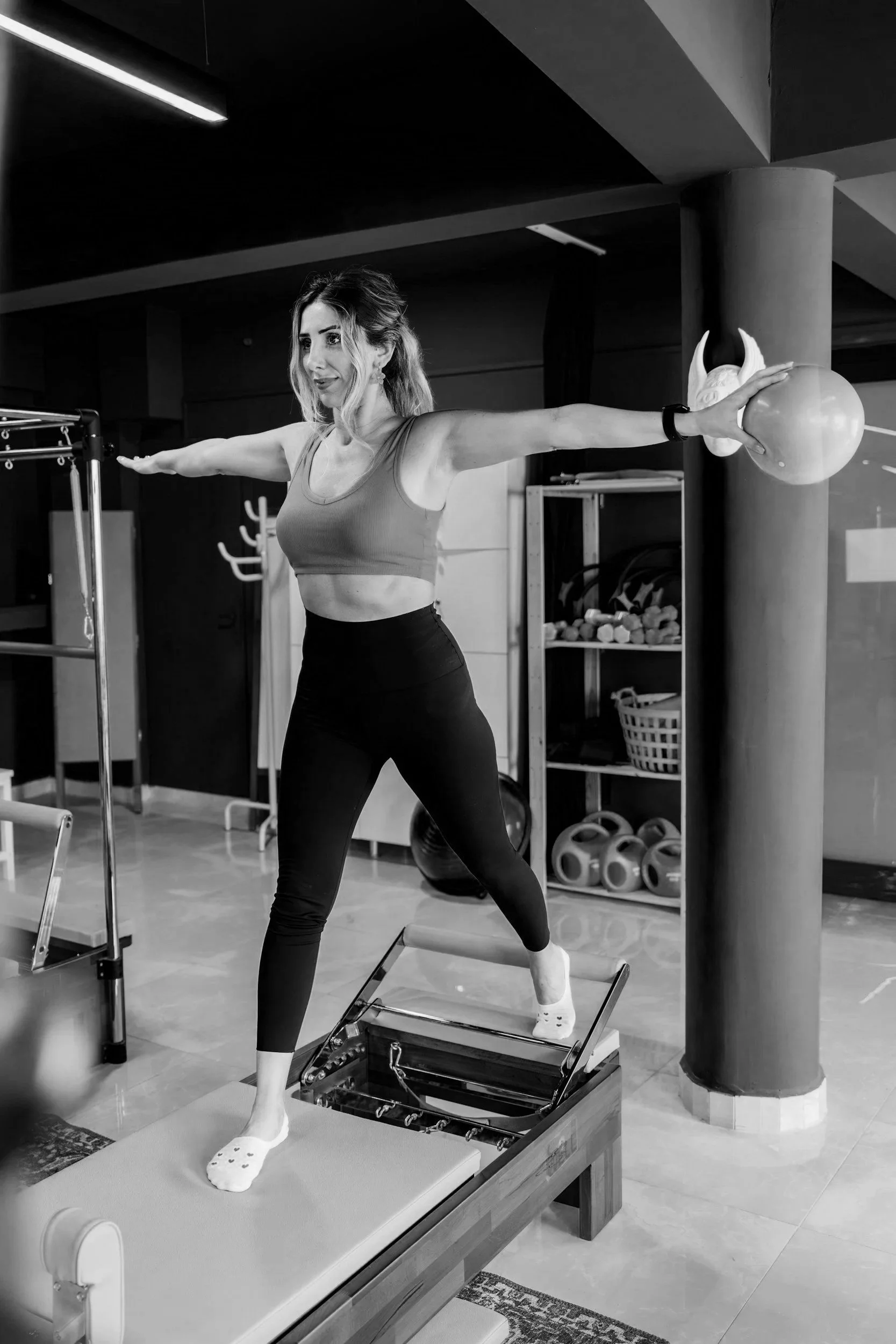
One of the clearest examples came from a balance progression we worked on next to the reformer.
We placed the box, standing upright, within reach. It wasn’t there to make the exercise easier. It was there to give people a way to regulate the amount of support they needed.
Some clients used a full hand on the box. Some stayed with fingertips. Some hovered their hand above the box and others brought their hands together or brought them overheard, we worked through the progressions and my clients chose their options as we moved through the work. That’s what progressions are for.
The goal isn’t to force everyone into the hardest version of an exercise. The goal is to help each person find the version where they can stay organized, challenged, and successful.
And honestly, that’s where a lot of good teaching happens.
Because once someone has enough support to stop panicking, they can actually feel what’s happening. They can notice the foot gripping. They can feel the hip shift. They can recognize when the breath disappears. They can start building the skill instead of just surviving the moment. Your job is to cue where they should feel it, adjust their bodies if they need it and help them feel success through the movement.
Support isn’t a step backward. It’s part of the progression.
Another class, another supportive box
The next progression showed the same thing in a different setup.
Rear facing lunge series: the box was on the carriage in short box position. Clients were rear-facing, with one foot on the carriage and the other on the platform. Starting with both palms on the box, the carriage moved slowly out into a lunge and then back in.
Simple on paper. Very honest in the body.
From there, the support changed:
Full palms on the box
Fingertips on the box
Hands hovering
Coming all the way up tall, if they felt ready that day
That progression sounds small, but it changes everything.
Flat palms give the body more confidence. Fingertips ask for more control. Hovering shows very quickly whether one side is more stable than the other. Coming up tall asks the body to own the work with less help. All the while, each progressions put more work into the standing leg quad and glute. They could feel it.
The exercise didn’t need to become louder, faster, or more complicated. The challenge came from reducing support with control.
That is the kind of progression I like, especially for balance work. It gives people options without making the exercise feel like a test they either pass or fail. My clients who fear balance and worry about being “unable to do an exercise",” have options, and they feel successful . . . that makes me happy!
None of that means the client is failing. It means the progression has a path.
I want clients to feel successful in the work they’re doing. Not because every exercise should feel easy, but because success builds trust. And trust matters when the body is learning how to feel steady again.
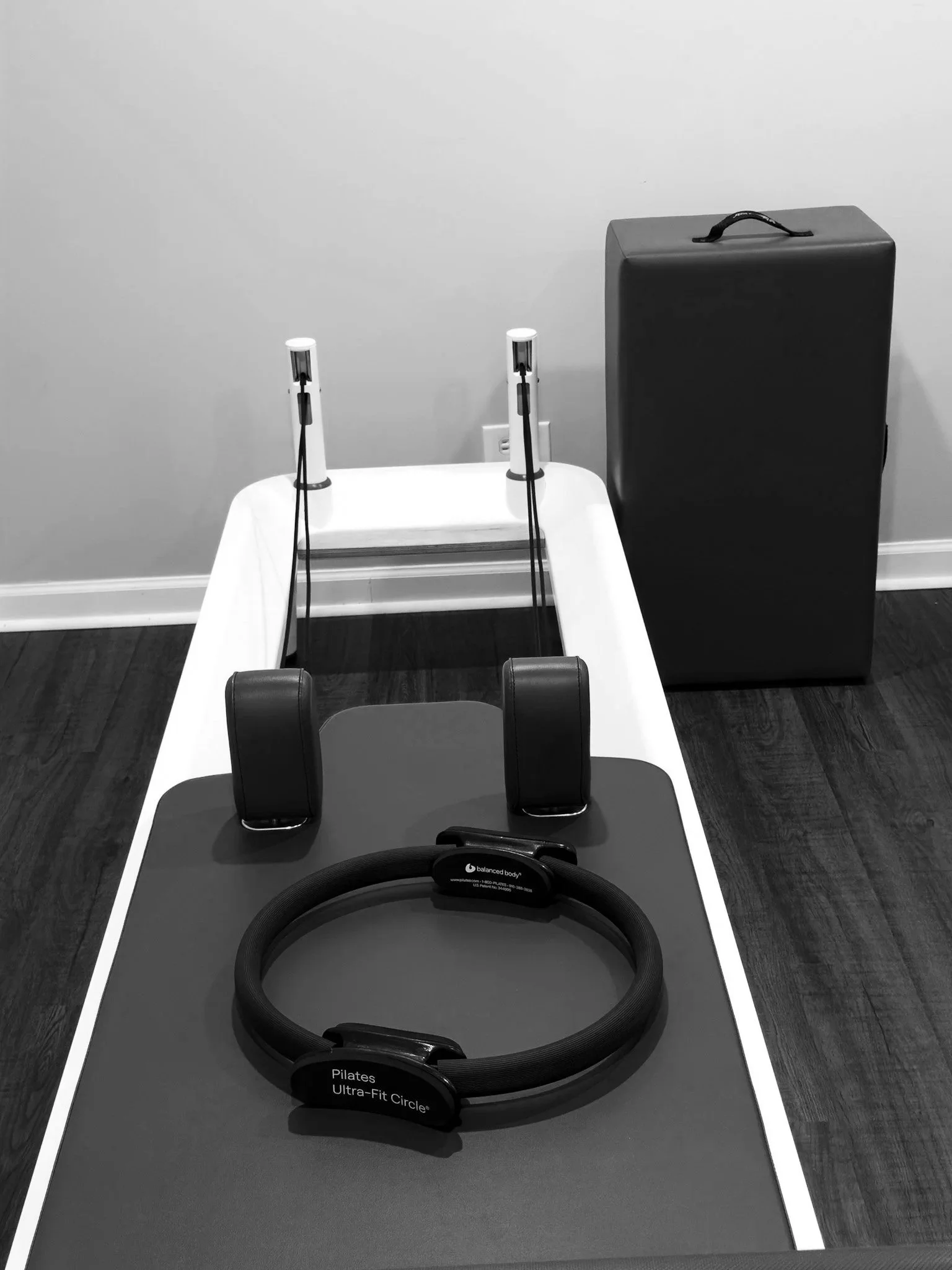
Support is part of the progression
There is a big difference between challenging balance and overwhelming the system. If someone is gripping, holding their breath, locking their joints, or looking terrified, they may not be training balance better. They may simply be surviving the exercise.
That is not the goal.
A hand on the box can be useful. Fingertips can be useful. Hovering the hand can be useful. These options create a path. They allow the body to feel what it needs, build confidence gradually, and progress without forcing it.
Support is not a step backward. It is part of the progression.
Balance training should build confidence, not make people feel exposed.
I want clients to feel successful in the work they’re doing. Not because every exercise should feel easy, but because success builds trust. And trust matters when the body is learning how to feel steady again.
What this gives instructors
For newer instructors, balance work can sometimes feel tricky to program. It’s tempting to either make it too simple or push the challenge too quickly.
But balance progressions don’t need to be dramatic to be effective.
A useful way to think about it is:
Start with enough support for the client to feel organized.
Reduce support gradually.
Watch what changes when the support gets lighter.
Give the client permission to return to support when needed.
Keep the goal on control, not performance.
That framework works whether you’re teaching single-leg balance, lunges, standing reformer work, step-ups, side splits, or even mat-based balance transitions.
The question isn’t just, “Can they do it?”
The better question is, “Can they stay connected while they do it?”
Can they breathe? Can they keep the standing foot from gripping? Can they control the hip? Can they notice when one side feels different? Can they use support without collapsing into it? Can they build confidence instead of bracing through the whole thing?
That’s where balance training becomes more than a wobble drill.
Why this matters before balance feels like a problem
Most people don’t think they need balance work . . . because daily life still feels normal. That’s exactly why it belongs in regular training. The goal isn’t to wait until balance feels noticeably off. The goal is to keep the systems that support balance responsive, while they still adapt well.
Sometimes that starts with one hand on the box. Sometimes it becomes fingertips. Sometimes it becomes a hover. Sometimes it becomes the realization that your fingertips were doing more work than you thought.
That’s not failure. It’s awareness. And awareness gives you somewhere to go.
Final Thoughts:
Balance starts to matter more after 40 because it’s so much more than just “standing on one leg.”
It’s strength. Coordination. Confidence. Reaction time. Foot awareness. Hip control. Breath. The body’s ability to respond when life shifts your weight without asking permission first.
Pilates helps train that in a way that’s thoughtful, progressive, and practical. It gives us ways to add support, reduce support, slow the tempo, adjust the spring, change the range, and build confidence without turning balance into a pass-or-fail test.
Balance is information.
And with the right kind of practice, it’s something you can keep building.