I say that I put a Pilates Filter on everything I do. That includes strength training.
But I want to be clear about what I mean by that, because I’m not turning a squat into Pilates. A squat is still a squat. An RDL is still an RDL. Picking up a pair of dumbbells doesn’t suddenly become Pilates because I move slowly or think about my alignment.
Strength stays strength. The Pilates Filter is the filter I put on it.
Pilates changed what I pay attention to
Before Pilates, I thought about exercise mostly in terms of the exercise itself. What am I doing? How many reps? What muscles am I working? Little bit of upper body, little bit of lower body . . . done.
Pilates made me pay attention to what was happening inside the movement.
Where am I stable? Where am I compensating? Can I maintain the position when the load changes? What happens when I take away one point of support? Can I control the movement in both directions? And maybe most importantly: am I actually doing what I think I’m doing?
That awareness followed me off the reformer.
It changed the way I approach a squat, a deadlift, a shoulder press and a row. It changed what I notice when I’m standing on one leg. It changed how I think about moving under load.
Not because Pilates owns any of those concepts. It doesn’t.
Control, alignment, stability, balance, breath and tempo all exist well beyond Pilates. Good strength coaches have been paying attention to them for a very long time.
Pilates simply changed the way I pay attention to them.
Strength still has to be strength
There’s a tendency to want to make everything “Pilates-inspired” if we add enough control, a little balance challenge and a tuck of the pelvis.
I don’t think we need to do that. If I’m strength training, strength is still the training goal.
I want enough resistance to challenge the movement. I want appropriate progression. I want muscles to have a reason to adapt. And depending on what I’m training, that may eventually mean using more load, changing the number of repetitions, increasing the difficulty or choosing a more demanding variation.
The Pilates Filter doesn’t replace any of that. It influences how I get there.
Truth be told, I don't lift super heavy . . . and I don't really want to, but that's a topic for another time.
Sometimes I slow it down, sometimes I use lighter weights
You’ll see me move deliberately in a lot of my strength work. That isn’t because slow movement automatically makes an exercise better, harder or somehow more Pilates.
Sometimes moving more slowly simply gives me more information, both in my own body and when I’m watching my clients go through the movement. The same goes for lighter weights.
If I slow down a single-leg RDL, I can feel when my pelvis starts to rotate, and I can see when a client is moving out of the work or compensating.
If I control the lowering phase of a squat, I have more time to notice whether I’m shifting to one side, whether the knees are knocking in or opening out too wide.
If I pause before pressing a weight overhead, I can check whether I’ve found stability before adding movement.
And if I can’t maintain the position at that speed or with that weight, that tells me something too. I often see clients want to "muscle through" with a weight they can't control, and they start to lose their form. Good form is way more important to me than the number on the dumbbell.
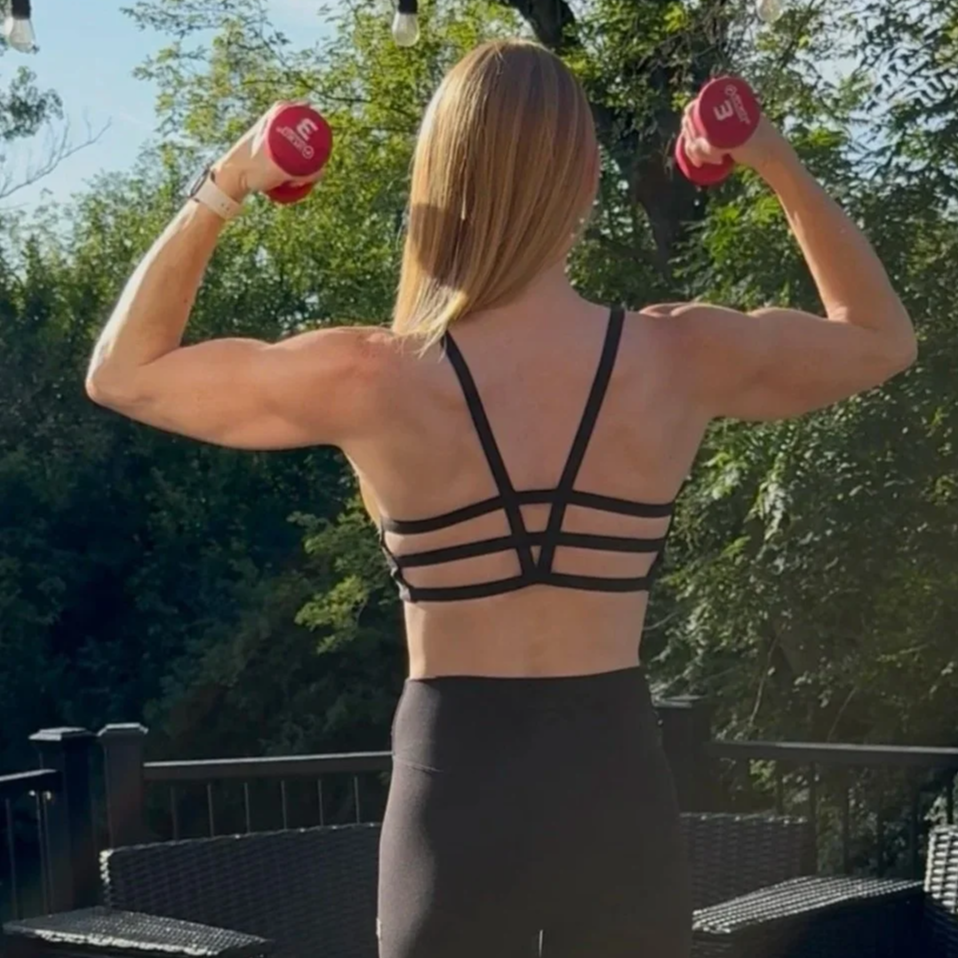
Speed and weight aren't the point, though.
Intent is.
There are times to move more quickly. There are times to lift heavier. There are times when the movement should feel athletic and powerful.
Putting a Pilates Filter on strength doesn’t mean making every exercise slow and precious, and it doesn't mean sticking with 1 lb weights.
It means paying attention while you do it, with whatever speed and weight you have.
Stability before complexity
One of the biggest things Pilates has influenced in my programming is how much I value stability.
Stability in the sense that the body has enough control to create movement from a useful place. I see this constantly in unilateral work.
Take a split-stance exercise, a single-leg hinge or a standing upper-body movement. The strength exercise may be targeting the glutes, hamstrings, back or shoulders, but there’s something else to look for at the same time.
Can you control your pelvis? Can you manage the shift in your center of gravity? Can you keep your trunk organized enough to move the load? Can you recover when you wobble?
That last one matters.
Balance isn’t the absence of movement. Sometimes balance is your ability to recognize that you’ve lost your position and find it again. That’s a very Pilates-way for me to think about strength.
If balance is the part that catches your attention, I wrote more about why it starts to matter differently after 40 and how Pilates gives us a way to actually train it.
The load is only part of the challenge
This is also why I don’t automatically dismiss lighter weights. A lighter dumbbell isn’t inherently easy, just as a heavier dumbbell isn’t automatically the right choice.
The question is what the exercise is asking you to do.
Five pounds in a simple bilateral movement is very different from five pounds when you’ve changed the lever, reduced your base of support, increased the range, added a unilateral demand or asked the body to maintain control somewhere else at the same time.
That doesn’t mean lighter weights are the answer to every strength goal. They aren’t.
It means load is one variable. I can change resistance. I can also change leverage, stability, range of motion, position, volume and complexity. The skill is knowing why I’m changing something.
That’s where the Filter comes in.
Pilates and strength don’t have to compete
I don’t think we need to choose between being a Pilates-girly or a gym-girly (or whatever you want to call yourself).
Especially after 40.
Pilates gives us an incredible environment for practicing control, coordination, balance, mobility and strength. Traditional strength training gives us opportunities to progressively challenge the body with external resistance.
Those things can coexist.
In my own movement and in the way I think about programming, I’m interested in the overlap without pretending they’re the same thing.
Sometimes I’m doing Pilates. Sometimes I’m strength training. Sometimes the two sit very comfortably beside each other. And when I move from one to the other, I don’t leave behind everything Pilates taught me simply because I picked up a dumbbell.
What the Pilates Filter actually looks like
For me, putting a Pilates Filter on strength might mean:
Establishing stability before I add more load.
Using unilateral work to expose differences between sides.
Paying attention to what the rest of the body is doing, not just the muscle I’m trying to train.
Choosing a tempo because it serves the exercise, not because slower automatically means better.
Progressing the challenge without sacrificing the purpose of the movement.
Using balance as something to train, not something you either have or don’t.
Letting control and strength develop together.
None of those things belong exclusively to Pilates. Pilates taught me to notice them.
The Filter isn’t the exercise. It’s the approach.
That may be the simplest way to explain all of this. I don’t put a Pilates Filter on strength because I think everything should become Pilates. I do it because Pilates changed the way I understand movement.
I notice stability. I notice balance. I notice control.
And I’m much more interested in whether someone owns a movement than whether they can simply get through it.
Strength still matters. Load still matters. Progression still matters. But so does what happens on the way there.
That’s the Filter. The Pilates Filter.